Wednesday, 18 September 2013

Use of Traditional Paddy Cultivation as a Means of Climate Change Adaptation in Sri Lanka

By Chatura Rodrigo
IPS 
Researcher

Paddy occupies approximately 37 per cent (0.77 million ha) of the cultivated land area of Sri Lanka.     It is cultivated during two major seasons; Yala and Maha, where a majority is cultivated during the latter. Close to 1.8 million farm families are dependent on paddy farming throughout the country. The demand for paddy in Sri Lanka will increase at a rate of 1.1 per cent per year, which requires production also to increase at a rate of 2.9 per cent per year. Therefore not only is paddy the staple food of the country, but its cultivation is the livelihood of a significant portion of people (DSC, 2013). 
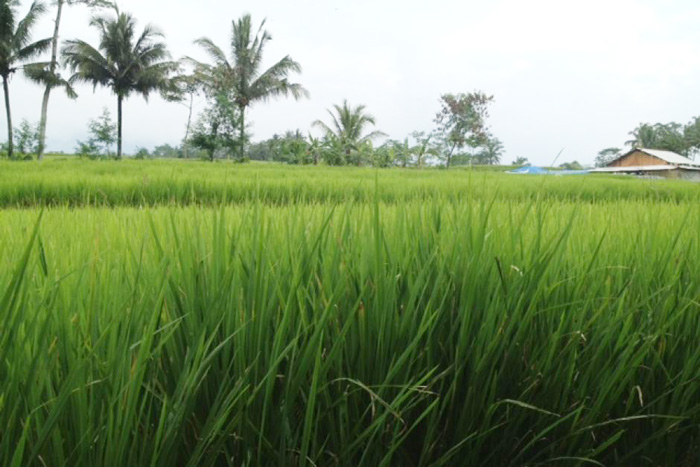
The ‘green revolution’ of the early 1960s, supported by agricultural policies such as fertilizer subsidies, placed Sri Lanka on the fast track to becoming a production economy. With subsidized fertilizer and the establishment of irrigation schemes, farmers were given the motivation to be more production oriented. These heavy production agricultural methods in the paddy sector were supported by the new and improved high yielding varieties. Even though these new improved paddy varieties were short termed and high yielding, they were chemical fertilizer and labour intensive and posed a negative externality to the environment (Wiggins and Brooks, 2010). Most importantly, these new improved production incentive paddy varieties and agricultural practices were not resilient towards climate change impacts.

Climate Change Models Shift Boundaries of Agro-Ecological Zones in Sri Lanka

By Muththuwatta, L.P. and Liyanage, P.K.N.C.

Climate change models for Sri Lanka suggest that profound and complex changes in rainfall patterns are becoming a reality.. It’s never too early to consider what this means and how it could impact agriculture and therefore all of us. 

The news that climate change will affect Sri Lanka’s weather will surprise very few these days. However, a recent study1 projecting rainfall distribution patterns in Sri Lanka for 2050 warns that climatic zones could shift. It also suggests that the intensity of rainfall will vary more greatly than observed over recent times. The findings reported by Muththuwatta and Liyanage, have important implications for agriculture – from farmers to policymakers.

With global temperatures warming over the past century, Sri Lanka has already displayed its share of signs of climate change. The resulting extreme weather events have even now affected agricultural production. Concerns for water and food security for a projected global population of 9.6 billion in 2050 are high. In its 2007 assessment report, the Intergovernmental Panel on Climate Change (IPCC) stated that the nature of changes will vary across different geographical regions and development statuses. It added that the way regions respond and adapt will also affect climate change.

Thursday, 4 April 2013

Certified Emission Reduction (CERs) Trading with EU Emission Trading System (EU-ETS): Are Developing Countries in a Crisis?

By Chatura Rodrigo
IPS Researcher 


Emission Trading Systems (ETSs) allow economies to trade the Certified Emission Reductions (CERs) through an open market mechanism. Countries engaging in Clean Development Mechanisms (CDM) projects generate CERs and then trade them, allowing project implementers to make profits while reducing carbon dioxide (CO2) and other greenhouse gas emissions. The European Union’s Emission Trading System (EU-ETS) was the main market place to trade the CERs generated through these CDM projects.

However, in their 2013-2020 agenda, the EU-ETS decided to only allow the trading of CERs that are being generated through CDM projects implemented in Least Developing Countries (LDCs).  Currently China and India are the main traders at the EU-ETS, and will definitely be affected by this decision. The first part of the article will provide a glimpse of the history of CERs, and how that developed into a market mechanism.  Next section will briefly introduce the EU-ETS and its importance to developing countries as a means of trading CERs. The latter part of this article will look at two decisions that the EU-ETS had taken, and how they will affect developing countries that are engaged in CDM projects particularly from a Sri Lankan perspective, as a country that is increasingly encouraging CDM projects.